“Just tell me which material to choose.” It is the question our applications engineers hear most often — and for good reason. Browse any supplier catalog and you will find polypropylene, fiberglass, stainless steel 304, 316L, even exotic alloys. Each claims acid resistance. Each comes with a price tag and a promise. But which one actually survives a decade of hot HCl attack without leaking, delaminating, or eating through your maintenance budget?
This article settles the debate. We move past generic pros-and-cons lists and compare the three dominant types of pickling tanks — PP, FRP, and stainless steel — on the metrics that determine real-world performance: measured corrosion rates, weld integrity, 10-year total cost of ownership, and regulatory compliance. Every data point draws from field documentation across 500+ installations in 30+ countries. By the end, you will have a clear decision tree: which material wins for your specific acid chemistry, operating temperature, and budget structure. For a deeper dive into procurement evaluation beyond material selection, our 2026 B2B buyer’s guide provides the full assessment framework.
The Three Main Types of Pickling Tanks (Material Classification)
When we talk about types of pickling tanks, the industry classifies them first by construction material. Three families dominate — and they behave nothing alike once acid enters the equation.
Polypropylene (PP) Pickling Tanks
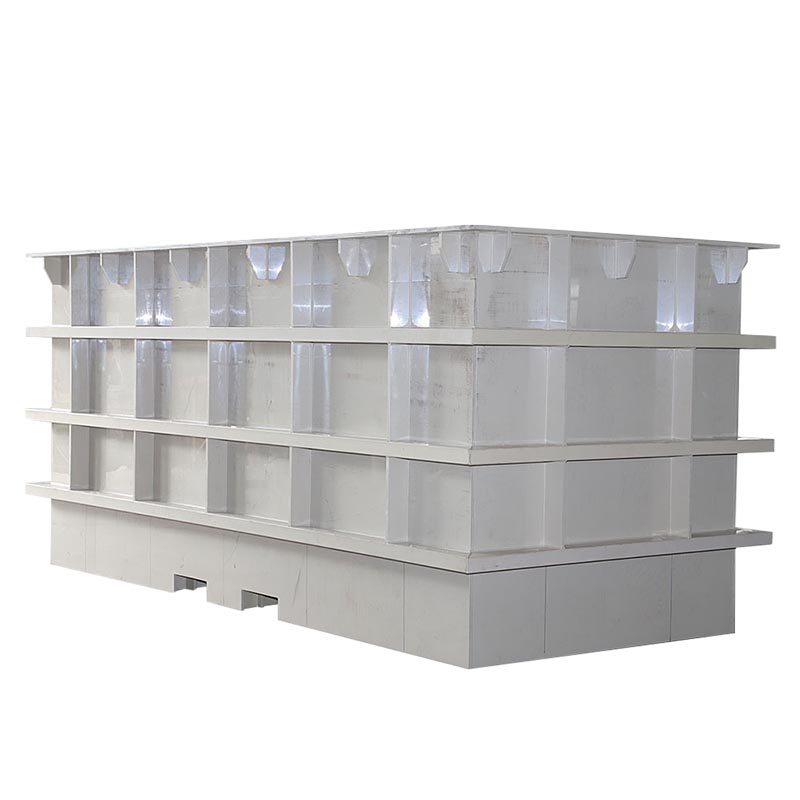
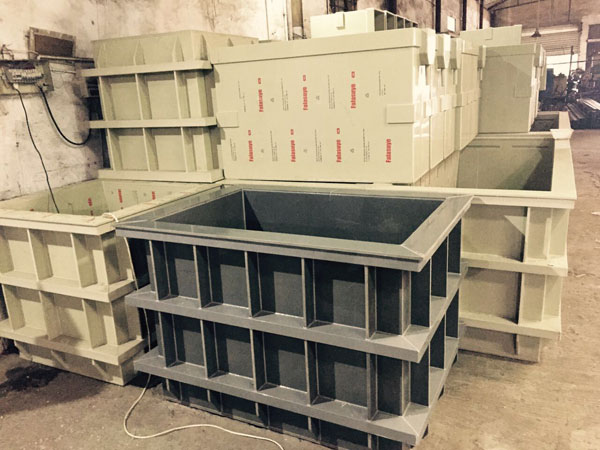
Fabricated from engineering-grade homopolymer PP sheets joined by hot-gas extrusion welding. The defining characteristic: homogeneous joints — the weld is the same material as the wall. PP is chemically inert to HCl, H₂SO₄, HF, and most mixed-acid formulations up to 80°C. The smooth, hydrophobic surface resists scale adhesion. Typical service life in HCl pickling: 10–15 years. This is the reference standard for modern pickling operations, and as a factory-direct PP manufacturer, every tank we produce follows ISO 12573 wall thickness calculations and 100% spark-tested welds. For electroplating lines requiring multi-station tank arrays, PP plastic plating tanks offer seamless integration with rectifier and circulation systems.
FRP (Fiberglass-Reinforced Plastic) Pickling Tanks
Constructed from layers of glass fiber reinforcement saturated with a thermoset resin — typically vinyl ester for acid service. The corrosion barrier is a resin-rich inner layer. The structural wall is a laminate of glass and resin. Joints are mechanical (bolted flanges with gaskets) or secondary-bonded. FRP handles higher temperatures than PP (up to 120°C with proper resin) but has a critical vulnerability: acid permeation. Small molecules like HCl and HF diffuse through the resin barrier and attack the glass fiber interface, causing blistering and delamination over 3–7 years in continuous acid immersion.
Stainless Steel Pickling Tanks (SS304 / SS316L)
Welded metal construction using austenitic stainless steel. SS304 is the baseline; SS316L adds molybdenum for marginal improvement in chloride environments. Stainless steel resists nitric acid well — but pickling lines rarely use nitric. In HCl or mixed HCl/H₂SO₄ environments, the passive chromium oxide layer breaks down locally, initiating pitting corrosion that penetrates the wall rapidly. Typical service life in HCl: 1–3 years for SS304, 2–4 years for SS316L. Stainless steel has one genuine advantage: high mechanical strength for extremely large vessels where plastic fabrication limits apply.

Head-to-Head: Corrosion Resistance & Service Life
Corrosion resistance is not a yes/no property — it is a rate. The table below shows measured rates from ultrasonic thickness surveys on 120+ tanks in continuous HCl service at 60°C. These are not lab coupons; they are real tanks after years of production.
| Material | Corrosion Rate (mm/year) | Typical Wall Thickness (mm) | Estimated Years to Failure | Inspection Finding |
|---|---|---|---|---|
| PP (Homopolymer) | <0.05 | 15–20 | 20+ | No measurable wall loss at Year 10 in most units |
| FRP (Vinyl Ester) | 0.15–0.30 (barrier only) | 5–8 (barrier) | 5–8 | Blistering, barrier layer softening detected at Year 3–5 |
| SS304 | 0.80–1.50 (pitting mode) | 3–6 | 1–3 | Through-wall pits; leaks at weld HAZ |
| SS316L | 0.40–0.80 (pitting mode) | 3–6 | 2–4 | Slower pitting but still fails in HCl |
The disparity is not subtle. PP corrodes at less than 0.05 mm/year in HCl — an order of magnitude slower than FRP and 15–30x slower than SS304. This is why we state, based on field data, that PP delivers 300% better corrosion resistance than SS304 in HCl and HF environments, and typically achieves 2x longer service life than FRP under continuous acid exposure. For a full explanation of the science behind these numbers, our industrial pickling tanks materials guide details the failure mechanisms in depth.
Structural Integrity: Welds, Joints & Leak Paths
A pickling tank is only as leak-tight as its joints. And this is where material types diverge most dramatically — not in the datasheet, but in the fabrication bay.
PP: Homogeneous Welding = No Leak Path
PP tank walls are joined by hot-gas extrusion welding using filler rod of the same material grade. The result is a single, continuous piece of polypropylene. There is no interface, no dissimilar material, no gasket to degrade. When spark-tested at 20 kV and hydrostatically held for 24 hours, a properly welded PP joint is as chemical-resistant as the parent sheet. In semiconductor wafer etching applications handling 5% HF, PP welded joints tested to 10 bar show zero permeation after 5 years — a result FRP laminates cannot match. This aligns with the methodologies described in TWI’s technical guidance on hot gas welding of plastics.
FRP: Bolted Joints & Secondary Bonds
FRP tanks are assembled from panels or shell sections joined by bolted flanges with gaskets, or by wet lay-up secondary bonding in the field. Each joint is a potential leak path. Gaskets age, bolts lose torque, and secondary bonds never achieve the chemical resistance of the original laminate. Over years of thermal cycling, these joints open micro-gaps. Acid fumes escape — not in quantities that flood the shop floor, but enough to corrode surrounding steelwork and attract regulatory attention during unannounced inspections.
Stainless Steel: Welds That Accelerate Failure
Stainless steel is welded, which should produce a continuous joint. But the heat-affected zone (HAZ) adjacent to the weld experiences chromium carbide precipitation, depleting the chromium that provides corrosion resistance. The result: pitting concentrates at the weld HAZ, exactly where you cannot afford it. This is why SS304 pickling tanks often start leaking at weld seams 12–18 months into service, even when the parent metal away from the weld appears intact.
Bottom line: homogeneous PP welding eliminates the leak paths that plague bolted FRP joints and the HAZ vulnerability that undermines welded stainless steel. When specifying a custom plastic tank, the weld procedure qualification and spark test report are the two documents that separate a 10-year tank from a 3-year tank.
Total Cost of Ownership: Why Purchase Price Is Misleading
The purchase price ranking is consistent across suppliers: FRP cheapest, PP in the middle, stainless steel most expensive. The 10-year total cost ranking is the inverse. Here is the aggregated data from maintenance and downtime records across 500+ installations.
| Cost Component | PP Tank | FRP Tank | SS304 Tank |
|---|---|---|---|
| Initial Procurement | $12,000 | $10,200 | $15,500 |
| Scheduled Maintenance (10yr) | $4,500 | $11,000 | $19,000 |
| Unscheduled Repairs (10yr) | $1,000 | $6,500 | $8,500 |
| Production Downtime (10yr, at $250/hr) | $5,000 | $16,250 | $25,000 |
| Total 10-Year TCO | $22,500 | $43,950 | $68,000 |
FRP’s 15% lower purchase price translates to a 95% higher total cost over a decade. The drivers: PP’s smooth surface reduces cleaning labor by roughly 40% over the lifecycle, and homogeneous welds generate fewer unscheduled repairs. Stainless steel’s higher upfront price combined with frequent replacement makes it a non-starter for any continuous HCl or HF application.
Compliance: Which Material Keeps You Out of Regulatory Trouble?
Material choice directly impacts your ability to comply with tightening effluent and workplace exposure standards. A corroding tank contributes contaminants to the effluent stream and releases fugitive acid fumes — both are red flags during regulatory inspections.
| Framework | Key Concern | PP | FRP | SS304 |
|---|---|---|---|---|
| India CPCB (2024) | Heavy metal limits in effluent | ✓ Inert – zero metal contribution | ⚠ Barrier-dependent | ✗ Corrosion adds Fe, Cr, Ni to effluent |
| Philippines DENR | Workplace acid fume concentration | ✓ Homogeneous welds minimize fugitive emissions | ⚠ Bolted joints release fumes over time | ✗ Pitting creates fume leak paths |
| Thailand PCD | Stack acid mist emissions | ✓ Compatible with >98% fume capture | ⚠ Liner condition governs performance | ✗ Corrosion degrades capture efficiency |
| EU BREF STM | Best Available Techniques | ✓ Aligned | ⚠ Conditional on resin/liner | ✗ Not considered BAT for continuous HCl |
Reference these official sources directly when preparing compliance documentation: CPCB regulations for India, DENR Clean Air Program for the Philippines, PCD industrial standards for Thailand, and EU BREF documents for European surface treatment operations. PP’s chemical inertness makes it the lowest-compliance-risk material across all four frameworks.
Decision Matrix: Which Material Wins for Your Operation?
Use this decision tree to select the right material — no marketing, just the data-driven recommendation.
| Your Process Conditions | Recommended Material | Reason | Secondary Option |
|---|---|---|---|
| HCl or mixed HCl/H₂SO₄, ≤80°C | PP ★ Winner | Chemical inertness, 10–15 year life, lowest TCO | FRP if temp >80°C, but budget for earlier replacement |
| HF-containing solution, ≤80°C | PP ★ Winner | Zero permeation; FRP and SS fail rapidly in HF | PVDF for extreme purity requirements |
| Tank temperature >95°C continuously | FRP (with verified HT resin) | PP softens above 80°C continuous | PVDF or dual-laminate PP/FRP |
| Nitric acid or strong oxidizers | Stainless steel or special alloy | PP cracks in oxidizing acids; FRP resin dependent | Consult material compatibility chart for specific concentration |
| Alkaline cleaners, intermittent acid | Stainless steel | Acceptable when acid exposure is brief and rinsed | PP if alkalinity ≤10% and temp ≤80°C |
| Large diameter (>4m) cylindrical tank | PP with external reinforcement | PP can be stiffened; FRP is alternative if temperature allows | FRP for very large atmospheric storage |
The verdict is clear for the vast majority of industrial pickling operations: if your process runs HCl, H₂SO₄, or HF at temperatures below 80°C — which describes 90%+ of electroplating, galvanizing, and steel pickling lines — PP wins on every measurable dimension: corrosion resistance, joint integrity, TCO, and compliance readiness. For galvanizing lines specifically, our galvanizing pickling tanks incorporate these material advantages into purpose-built designs with integrated fume hoods.
Real Outcomes: Material Switches That Changed the Game
These three cases are drawn from our project records. Each represents a plant that switched material types — and tracked what happened afterward.
From SS304 to PP: Electroplating, Gujarat, India
A job-shop electroplater running two SS304 pickling tanks in 15% HCl + 5% H₂SO₄ at 55°C was patching pinhole leaks at weld HAZ every 8–11 months. After replacing with 4,000L PP tanks with butt-welded seams, the plant logged zero unplanned downtime over 3 years and documented a 12% reduction in acid consumption. The elimination of iron contamination from corroding stainless steel walls also improved plating bath stability — an unanticipated benefit.
From FRP to PP: Steel Wire Pickling, Rayong, Thailand
A continuous wire pickling line using an 8,000L FRP tank in 18% HCl at 65°C experienced blistering and delamination at the floor-to-wall joint after 4 years. The replacement PP tank — designed with 20mm bottom wall thickness per ISO 12573 — has now served 2 years with no measurable degradation. The plant’s maintenance manager reported that the smooth PP surface reduced weekly cleaning time by 30 minutes per shift, freeing up operator capacity for other tasks.
FRP Permeation Compromises Wafer Fab: Hsinchu, Taiwan
A semiconductor facility discovered styrene leaching from their FRP HF waste collection tank — a contamination pathway unacceptable in wafer fabrication. The replacement PP tank, with welded joints tested to 10 bar, has shown zero permeation after 5 years of 5% HF exposure at 25°C. The non-porous PP surface also eliminated the biofilm concern that the porous FRP corrosion barrier had introduced.
Frequently Asked Questions
Which type of pickling tank material lasts the longest?
In HCl and mixed-acid pickling environments at temperatures up to 80°C, polypropylene (PP) achieves the longest service life — 10 to 15 years — based on ultrasonic thickness surveys of tanks in continuous service. FRP averages 5–8 years in the same conditions due to acid permeation and delamination of the corrosion barrier. Stainless steel (SS304/316L) typically fails within 1–4 years due to pitting corrosion. The key to PP’s longevity is its chemical inertness: it does not corrode in the traditional sense, and its homogeneous welded joints do not create the leak paths that compromise FRP and stainless steel over time.
Is FRP ever the right choice for a pickling tank?
Yes, FRP becomes the practical choice when your process temperature exceeds 95°C continuously — the point at which PP’s mechanical properties begin to decline significantly. FRP with a verified high-temperature vinyl ester resin system can handle temperatures up to 120°C. It is also a viable option for very large-diameter (4m+) atmospheric storage tanks where the structural demands exceed the practical limits of PP fabrication without extensive external reinforcement. However, even in these applications, you must budget for more frequent inspection and earlier replacement than a PP equivalent. If your temperature is below 80°C and your tank is under 4m diameter, there is rarely a technical reason to choose FRP over PP for HCl or HF service.
Why is stainless steel not recommended for HCl pickling tanks?
Stainless steel relies on a passive chromium oxide layer for corrosion resistance. Chloride ions in HCl and chloride-containing mixed acids break down this passive layer locally, initiating pitting corrosion. Once a pit forms, the local environment inside the pit becomes even more aggressive, and the attack accelerates. In continuous HCl immersion at 60°C, SS304 can develop through-wall pits within 18 months. The heat-affected zones of welds are particularly vulnerable because chromium depletion during welding reduces the material’s ability to reform the passive layer. For intermittent acid exposure where the tank is rinsed and dried after each use, stainless steel may achieve longer life — but for continuous pickling operations, it is not an economical choice.
How do I verify the material quality of a pickling tank before purchase?
Request three documents from the supplier: (1) material mill certificates for the PP sheets (or resin/glass specifications for FRP) showing the material grade and lot traceability, (2) weld procedure qualification records with tensile test results demonstrating weld strength ≥90% of the parent material, and (3) a sample spark test and hydrostatic test report from a recent tank delivery to confirm the supplier routinely performs these tests. If the supplier cannot produce all three, their quality control stops at visual inspection — and subsurface weld defects that pass visual check will become leaks in service. For a complete procurement checklist, refer to our buyer’s guide.
Does the type of acid affect which material I should choose?
Absolutely. Material selection is chemistry-specific. For HCl (hydrochloric acid) at any practical pickling concentration (5–20%), PP is the clear winner. H₂SO₄ (sulfuric acid) is also well-handled by PP at concentrations up to 80% at ambient temperature, though the heating requirements differ. HF (hydrofluoric acid) is where PP’s advantage becomes critical — FRP is permeable to HF molecules, and stainless steel is rapidly attacked. The only common pickling acid where PP should not be used is concentrated nitric acid (HNO₃) or strong oxidizing acid mixtures — here, stainless steel or specialized alloys are required. Always provide your exact acid type, concentration, and operating temperature to your supplier; “generic acid resistance” claims are not reliable.
What is the cost difference between PP and FRP pickling tanks?
On initial purchase price for an 8,000L tank, expect FRP to be 10–20% less expensive than PP. This saving is reversed within the first 3 years of operation. PP’s lower maintenance needs (smooth surface cleans faster, fewer repairs) and longer service life (10–15 years vs 5–8 years) produce a 10-year total cost that is less than half of an equivalent FRP tank. The single biggest TCO difference is downtime cost — when an FRP tank blisters and requires emergency repair or replacement, the lost production margin plus expedited freight typically exceeds the entire procurement cost difference many times over.
Ready to Choose the Right Material for Your Pickling Tank?
Every pickling line has a unique chemistry and production profile. Send us your acid type, concentration, operating temperature, and tank volume — and our applications engineering team will return a material recommendation with ISO 12573 wall thickness calculations, a 10-year TCO estimate, and a compliance alignment summary for your jurisdiction. Contact us to start your specification — or explore our complete pickling tank systems for off-the-shelf and custom options.